
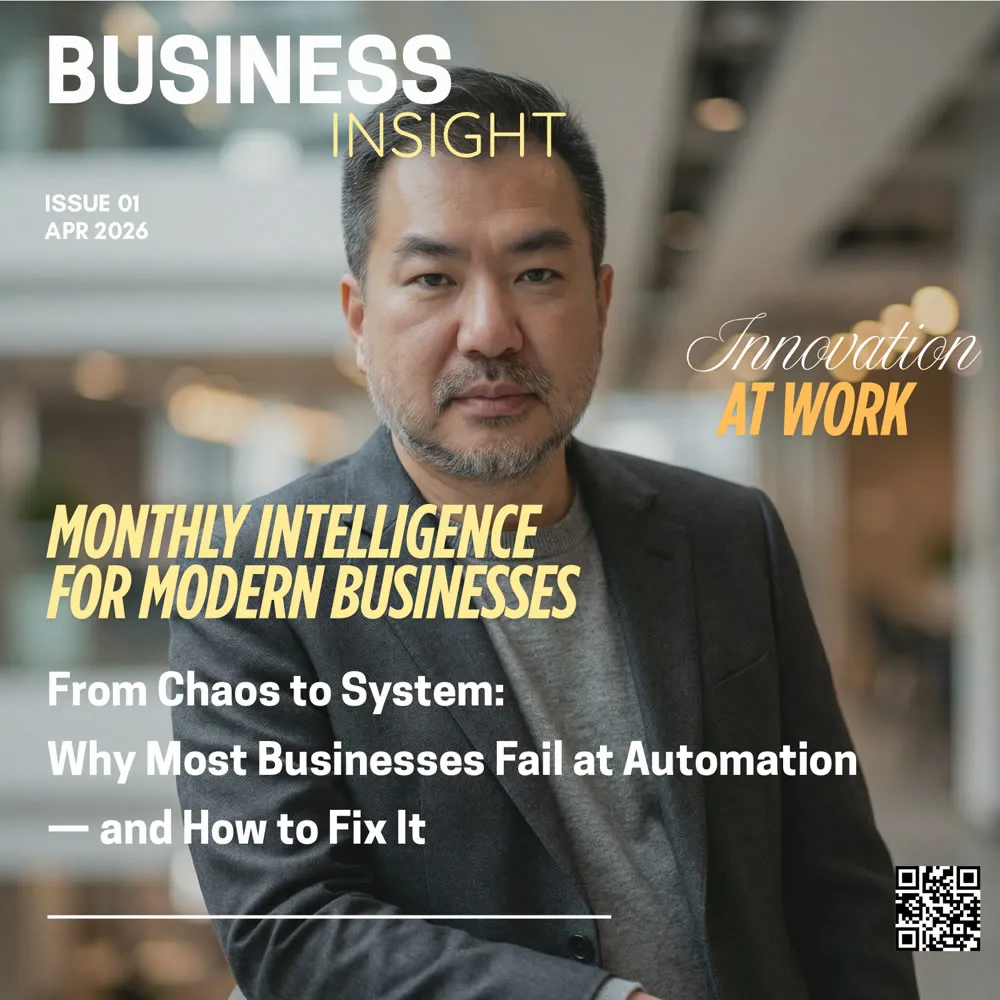
Most businesses today are investing in tools, software and AI. Yet many still struggle with inefficiency, errors and operational chaos. In this issue, we explore a simple question: why do so many automation efforts fail, and what actually works instead?
The biggest mistake businesses make is starting with tools instead of problems. Many companies think adopting AI means buying software or implementing the latest technology. In reality, most inefficiencies come from poorly structured workflows, not a lack of tools. If the underlying process is unclear, adding technology only makes the chaos faster.
Automation projects fail because the underlying operations are not structured properly. Common issues include uncoordinated multi-channel order intake that leads to data conflicts and duplication, manual data handling across teams that introduces errors and delays, no real-time visibility into operations and order status, and heavy reliance on key individuals rather than documented systems.
Our approach is the KWD OPG Framework™, in three stages: Optimise (identify inefficiencies and bottlenecks), Process (redesign workflows into a structured system) and Generate (implement technology and automation). The key difference is that we don’t start with technology. We start with understanding the business.
A cleaning company we worked with was managing bookings through WhatsApp and Excel. Jobs were missed, staff were misallocated and invoicing was delayed. We centralised all bookings into a single system, automated job assignment based on availability, introduced real-time job tracking and enabled automatic invoicing on job completion. The result was a smoother operation, fewer errors and improved cash flow.
The biggest improvements usually come from reduced manual workload, fewer operational errors, faster processing, better visibility across the business and increased scalability. Most importantly, the business becomes less dependent on individuals and more driven by systems.
Three signs your business needs systemisation: your team spends hours on repetitive manual tasks; you rely on multiple disconnected tools or spreadsheets; you lack real-time visibility into operations. These are not technology problems. They are structure problems. Technology should support a well-designed system, not replace it.